
Insignia of the Sacred Band
This cap badge was worn by members of the Sacred Band led by Alexandros Ypsilantis. It is the only surviving example.
Patras · Peloponnese
Museum of the Historical and Ethnological Society of the Peloponnese
Founded in 1968, the Historical and Ethnological Society of the Peloponnese works to preserve and share the region’s historical heritage. Its Museum brings together artefacts, historical records and stories that connect Patras and the Peloponnese with defining moments in modern Greek history.
The Museum
In 1968, twenty people from Patras came together to found the Historical and Ethnological Society of the Peloponnese, united by a commitment to preserving and promoting the region’s historical heritage.
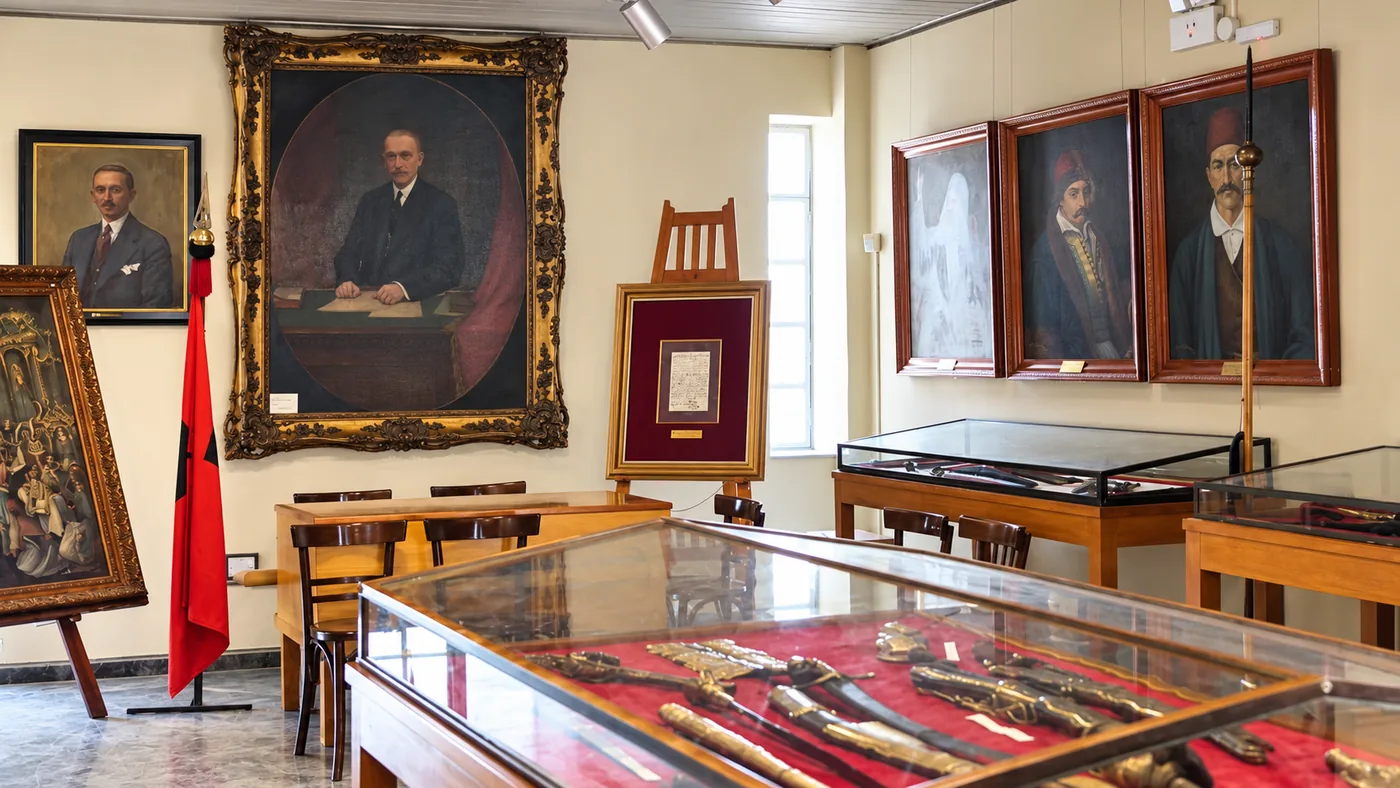
Following the Society’s formal recognition, its members, supported by many other people from Patras, set about establishing a museum and assembling a collection of objects of historical significance.
The Museum is housed on the sixth floor of the Megaro Logou kai Technis (House of Letters and Arts), on 17 George I Square in Patras. The premises were made available by the Municipality of Patras, and the Museum has remained in continuous operation there for more than fifty years.
The Museum’s collections span the final centuries of Ottoman rule and subsequent periods of modern Greek history. They include historical artefacts, works of art, engravings, weapons, period dress, documents, photographs, medals and personal belongings of prominent figures.
Enriched through donations and new additions, the collection continues to grow, keeping the connection between past and present alive.
The Collections
People, struggles and defining moments in modern Greek history come to life through the objects and historical records preserved in the Museum’s collections.
This cap badge was worn by members of the Sacred Band led by Alexandros Ypsilantis. It is the only surviving example.
Ορειχάλκινο αντίγραφο εκμαγείου του προσώπου του Θεόδωρου Κολοκοτρώνη, το οποίο λήφθηκε μετά τον θάνατό του.
A Gospel book cover of Russian craftsmanship, placed on the body of Gregory V, Patriarch of Constantinople, at his burial in Odessa in 1821, following his execution by hanging. It was recovered when his remains were exhumed in 1871 and was brought to Athens together with them.
Personal belongings of Dimitrios Gounaris, including his spectacles, a dip pen and a vessel bearing his monogram, as well as two Grand Cross decorations awarded to him.
Ioannis Papadiamantopoulos, better known as Jean Moréas (1856–1910), was a poet with family roots in Patras who became an important figure in French literature. He was appointed a Knight of the Legion of Honour by the French state in recognition of his literary achievements.
A wooden cartridge box engraved with depictions of Saint George and Saint Demetrius.
Your Visit
In the Heart of Patras
17 George I Square
Megaro Logou kai Technis (House of Letters and Arts) · 6th floor
Through partnerships and publications, the Museum broadens its work and contributes to the study, preservation and sharing of historical and cultural heritage.
The Museum works with cultural organisations, associations and foundations throughout Greece. One particularly valued partnership is with the “Dionysios Solomos” Friends of Music Association in Messolonghi.
Frequently Asked Questions
**FAQ subtitle** Everything you need to know before visiting the Museum.